
Categories: Seminari
Tags: Evoluzione Stellare Nucleosintesi Supernove
Posted by: Eleonora Ferroni
Date: Gen 19, 2026
Heavy Elements as Clues to the Progenitors of Type Ia Supernovae
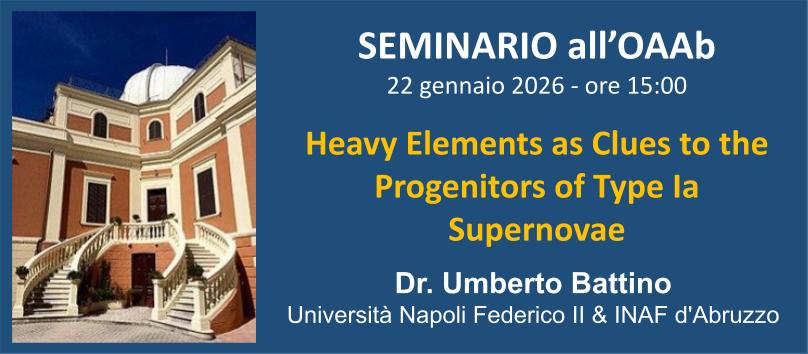
Giovedì 22 gennaio alle ore 15:00, il Dott. Umberto Battino (Università degli Studi di Napoli Federico II & INAF – Osservatorio Astronomico d’Abruzzo, IT) terrà il seminario dal titolo “Heavy Elements as Clues to the Progenitors of Type Ia Supernovae”.
Abstract:
A Type Ia supernova (SNIa) marks the catastrophic explosion of a white dwarf in a binary system. These events play a crucial role in galactic chemical evolution and serve as pivotal standardizable candles for measuring cosmic distances, underpinning the discovery of the Universe’s accelerated expansion. However, the progenitors of SNIa remain uncertain, introducing challenges to their use in cosmology and nucleosynthesis predictions.
We investigated the evolution and nucleosynthesis of slowly merging carbon-oxygen white dwarfs approaching the Chandrasekhar mass. We tested a variety of physics input settings, including accretion rates, nuclear reaction rates, convection parameters, and the composition of the accreted material. During the merger process, as the mass of the primary white dwarf approaches the Chandrasekhar limit, carbon burning is initiated first on the surface before eventually igniting explosively at the center. As a consequence, the 22Ne(α,n)25Mg reaction activates in the outer layers of all models, producing a weak s-process-like abundance pattern, peaking at Kr, overproduced by a factor of ∼1000 compared to solar. The trans-Fe elements-enriched outer layer mass varies fro 0.05~M⊙ to 0.11~M⊙, depending on the accretion rate. Our explosion simulations of these progenitor models eject significant amount of first-peak elements (e.g., Se, Kr) as well as some long-lived radioactive species, such as 60Fe.
Previous theoretical studies found that a similar nucleosynthesis process during the progenitor phase may also occur on the surface of near-Chandrasekhar white dwarfs formed through the accretion of H-rich material via the single-degenerate scenario. Therefore, these results suggest trans-Fe enrichment might be a hallmark of near-Chandrasekhar SNIa ejecta, regardless of the specific progenitor channel, and could provide a new spectral signature distinguishing them from sub-Chandrasekhar explosions.
Si può partecipare di persona in ex Aula Cosmologie Antiche.
Per partecipare online clicca qui: meet.google.com/pdy-bpuf-jsg
Related Posts
-
From questions to answer: the Milky Way bulge with MOONS
-
Building dwarf galaxies from the bottom up: evidence for dwarf–dwarf mergers in the nearby Universe
-
Galaxy morphology across cosmic time: environment, evolution, and the MICADO breakthrough
-
Why we still can’t model our Universe: A Guide to Quantum Gravity


Comments are closed.