Ott 1

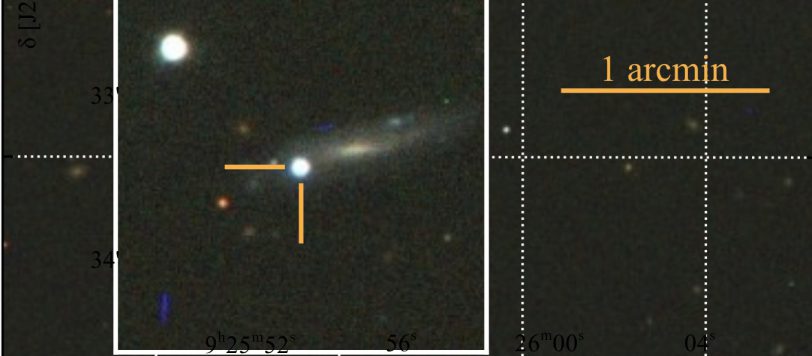
Supernova 2020able: Cronaca della fine di una stella massiccia

Osservata a partire da meno di 24 ore dall’esplosione, la supernova SN 2020able ha offerto una rara fotografia degli ultimi mesi di vita di una stella massiccia. I risultati dello studio, guidato da Leonardo Tartaglia, ricercatore dell’INAF d’Abruzzo, sono pubblicati sulla rivista Astronomy & Astrophysics (vai all’articolo). Grazie a osservazioni nell’ultravioletto e nell’ottico, effettuate con […]
Mag 28

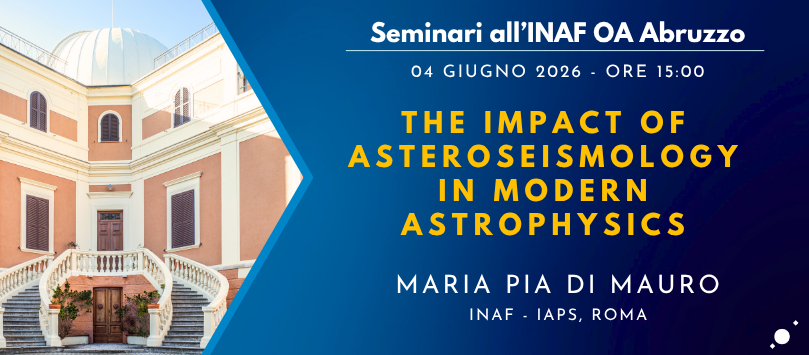
The impact of asteroseismology in modern astrophysics

Giovedì 04 giugno alle ore 15:00 Maria Pia Di Mauro (INAF – Istituto di Astrofisica e Planetologia Spaziali, Rome, Italy) terrà un seminario dal titolo “The impact of asteroseismology in modern astrophysics“. Abstract: Asteroseismology has evolved from a largely descriptive discipline into one of the most powerful diagnostic tools in modern astrophysics, providing unique constraints on the internal […]

Mar 20

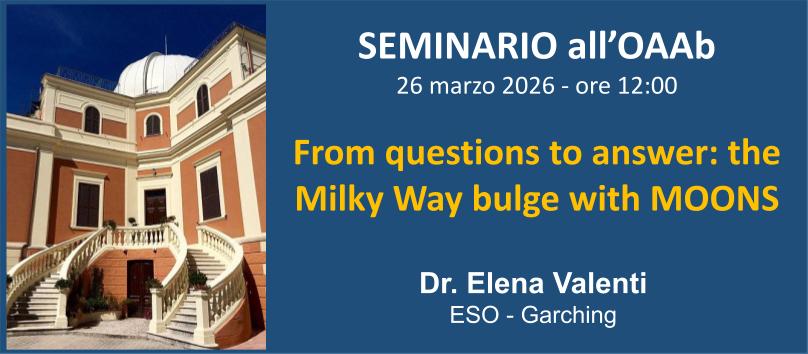
From questions to answer: the Milky Way bulge with MOONS

Giovedì 26 marzo alle ore 12:00 Elena Valenti (European Southern Observatory, Garching – Germania) terrà un seminario dal titolo “From Questions to Answer: The Milky Way bulge with MOONS”.  ABSTRACT: The formation of bulges remains one of the key open questions in galaxy evolution. Several mechanisms have been proposed – such as the dynamical instability […]

Gen 19

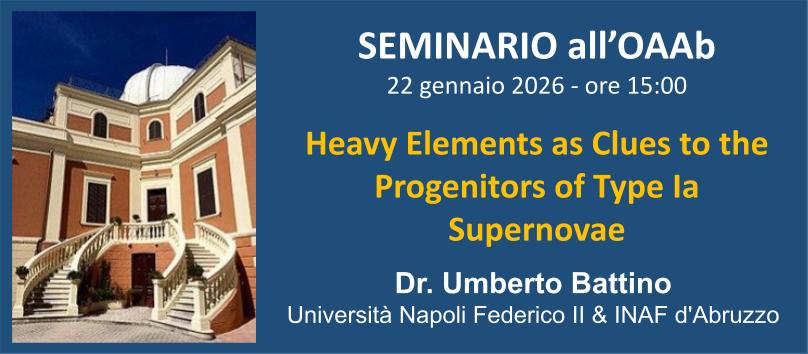
Heavy Elements as Clues to the Progenitors of Type Ia Supernovae

Giovedì 22 gennaio alle ore 15:00, il Dott. Umberto Battino (Università degli Studi di Napoli Federico II & INAF – Osservatorio Astronomico d’Abruzzo, IT) terrà il seminario dal titolo “Heavy Elements as Clues to the Progenitors of Type Ia Supernovae”. Abstract: A Type Ia supernova (SNIa) marks the catastrophic explosion of a white dwarf in a binary system. […]

Dic 4

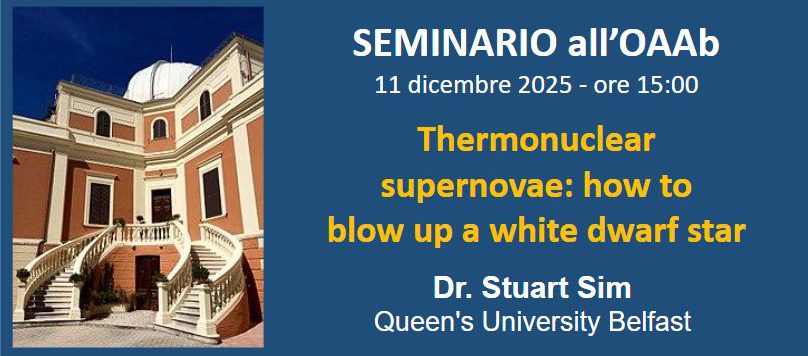
Thermonuclear supernovae: how to blow up a white dwarf star

Giovedì 11 dicembre alle ore 15:00, il Dott. Stuart Sim (Queen’s University Belfast, UK) terrà il seminario intitolato “Thermonuclear supernovae: how to blow up a white dwarf star”. Abstract: Aside from being spectacular displays in their own right, Type Ia supernova explosions have a key role in measuring the expansion history of the Universe and synthesizing the iron […]

Nov 3

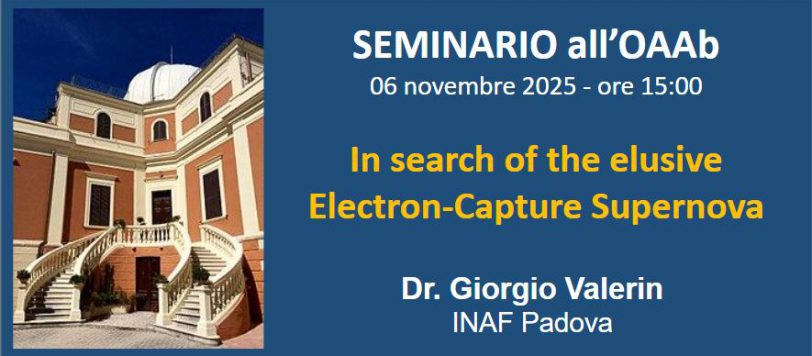
In search of the elusive Electron-Capture Supernova

Giovedì 06 novembre alle ore 15:00, il Dott. Giorgio Valerin (INAF – Osservatorio Astronomico di Padova) terrà il seminario dal titolo “In search of the elusive Electron-Capture Supernova”. Abstract: Electron-Capture Supernovae (ECSNe) are a type of weak stellar explosions theorised to arise from stars with initial masses roughly between 8 and 10 solar masses. Models which […]

Ott 16

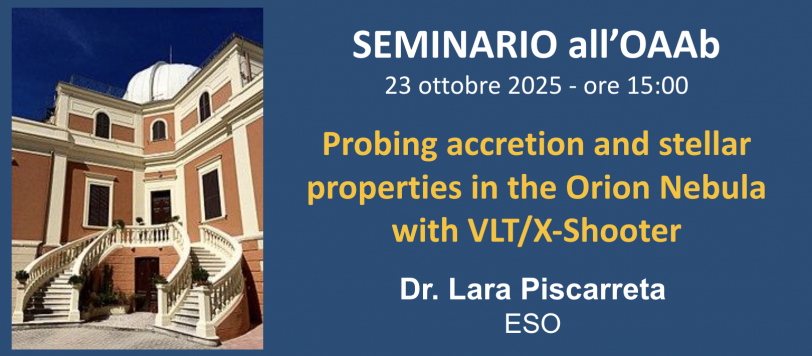
Probing accretion and stellar properties in the Orion Nebula with VLT/X-Shooter

Giovedì 23  ottobre alle ore 15:00, la Dott.ssa Lara Piscarreta (ESO – Garching, Germany) terrà il seminario dal titolo “Probing accretion and stellar properties in the Orion Nebula with VLT/X-Shooter”. Abstract: As the environments where planets form, protoplanetary disks provide fundamental insights into the conditions for planet formation. Particularly, the timescale of disk dispersal defines […]

Ott 9

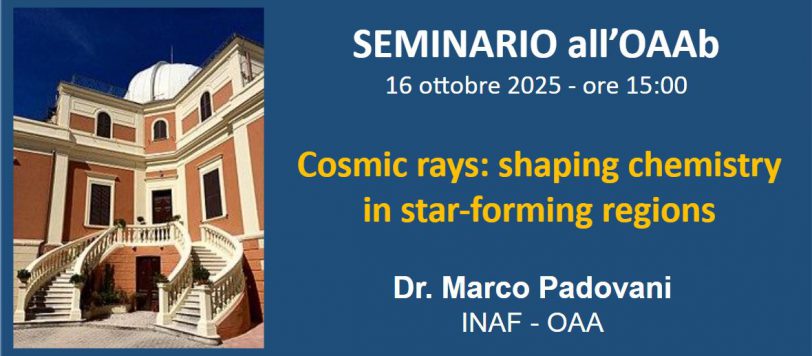
Cosmic rays: shaping chemistry in star-forming regions

Giovedì 16 ottobre alle ore 15:00, il Dott. Marco Padovani, dell’INAF-Osservatorio Astrofisico di Arcetri, terrà il seminario dal titolo “Cosmic rays: shaping chemistry in star-forming regions”. Abstract: Low-energy (<1 GeV) cosmic rays are a key element in several physical and chemical processes of the interstellar medium, from the large scales of molecular clouds to the […]

Set 12

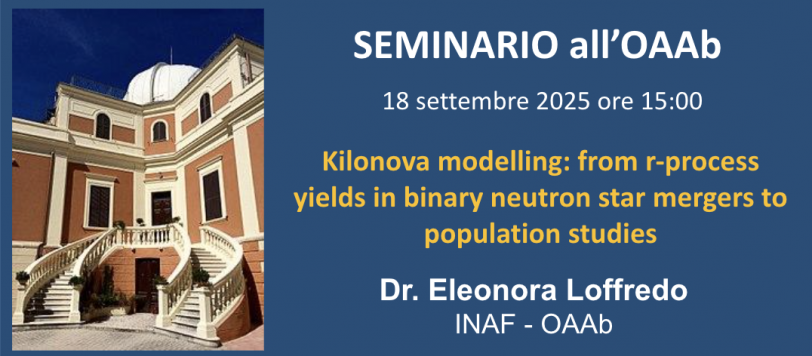
Kilonova modelling: from r-process yields in binary neutron star mergers to population studies

Giovedì 18 settembre aprile alle ore 15:00, la Dott.ssa Eleonora Loffredo, dell’INAF-Osservatorio Astronomico d’Abruzzo, terrà il seminario dal titolo “Kilonova modelling: from r-process yields in binary neutron star mergers to population studies”. Abstract: Binary neutron star (BNS) mergers eject neutron-rich matter, providing ideal conditions for the nucleosynthesis of heavy elements via the r-process. The radioactive […]

Lug 25

“Tensione di Hubble”, continua l’indagine sull’enigma della cosmologia moderna

Come si espande l’universo? Al centro di questo mistero c’è un numero cruciale, la costante di Hubble, che dovrebbe dirci con quale velocità lo spazio cosmico “si allarga”. Il problema è che metodi di misurazione diversi, forniscono valori significativamente diversi di questa costante: da qui la Tensione di Hubble. Usando il telescopio spaziale James Webb, […]