
Why the PSF matters in Adaptive Optics imaging of stellar fields (and how to deal with it!)
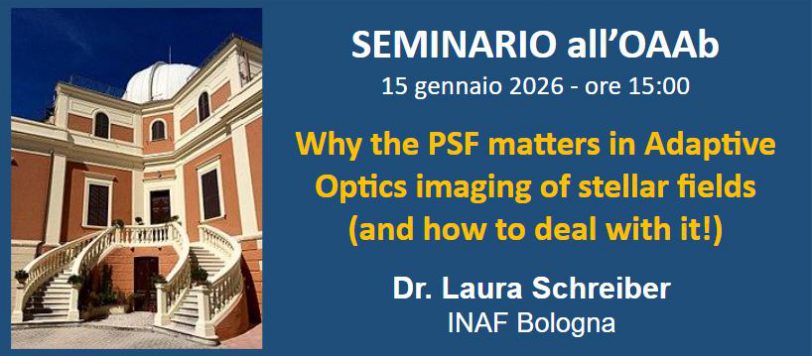
Giovedì 15 gennaio alle ore 15:00, la Dott.ssa Laura Schreiber (INAF-OAS, Bologna) terrà il seminario dal titolo “Why the PSF matters in Adaptive Optics imaging of stellar fields (and how to deal with it!)”.
Abstract:
The Point Spread Function (PSF) describes how an imaging system responds to a point source. Accurate knowledge of the PSF is essential to achieve high-precision astrometry and photometry, especially in crowded stellar environments, where even small modelling errors can propagate into significant systematic effects.
In this talk, I will introduce the concept of the PSF from basic image-formation principles and discuss how its properties change across different observational regimes, from seeing-limited observations to diffraction-limited space imaging. Within this framework, I will highlight why Adaptive Optics (AO) data of stellar fields represent one of the most challenging cases. Adaptive Optics systems are designed to compensate for the wavefront distortions introduced by Earth’s atmosphere through real-time measurements and corrections, allowing ground-based telescopes to approach their diffraction limit. While this dramatically improves angular resolution, it also introduces additional complexity in the resulting instrumental response.
As a result, AO-corrected images of stellar fields are characterised by a highly structured PSF, featuring a diffraction-limited core surrounded by a residual seeing halo. Depending on the Adaptive Optics flavour and observing conditions, the PSF may also exhibit spatial variability across the field of view. These properties make standard analysis approaches based on simple analytic PSF models often inadequate and currently represent one of the main limitations in fully exploiting the scientific potential of AO observations in crowded stellar environments.
Through a series of illustrative examples, I will review the main physical and instrumental contributors to PSF complexity and variability in stellar fields, and discuss how different PSF modelling strategies impact the accuracy of astrometric and photometric measurements. I will then introduce empirical approaches to PSF estimation as a practical and robust solution for crowded-field AO imaging. As a concrete example, I will briefly present the Starfinder software, which is based on a fully empirical extraction of the PSF directly from the science data of stellar fields, and outline ongoing efforts to modernise and translate this approach into a Python-based framework. This example will serve to illustrate how careful PSF treatment enables high-precision science from current and future AO facilities, like the ELT.
Related Posts
-

Campionati italiani di astronomia: la fase interregionale a Teramo dal 24 al 25 febbraio
-

Studiare le onde gravitazionali dalla Luna con LGWA
-
Galaxy morphology across cosmic time: environment, evolution, and the MICADO breakthrough
-

Diversity Media Research Report 2025: come migliorare l’inclusione nella comunicazione e nella scienza


Comments are closed.